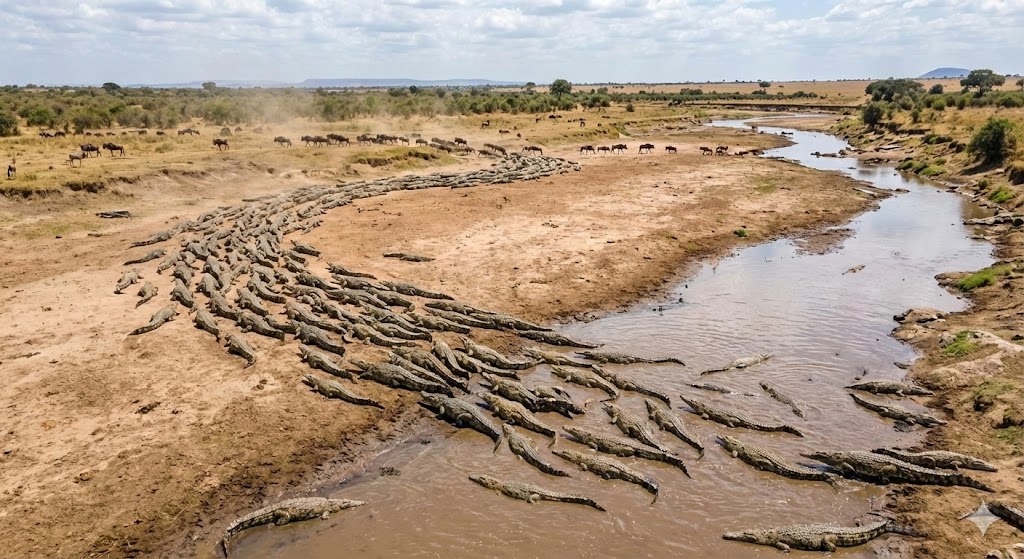
Lecturer: Around ten years ago, Australia Zoo, the University of Queensland, and Queensland Parks and Wildlife undertook a project to monitor the movements and behavior of the crocodiles in Lakefield National Park. The aim of the study was to provide better information on how adult crocodiles there interact within a river system, enabling people to have better decisions on how to manage crocodile populations. 1This project can lead the world in crocodile management because of the use of satellite, which enables scientists to stably receive accurate information being sent back to them on the computer. Even though the crocodiles can travel very long distances, scientists can still know where they are and study their habits. The study is going to help scientists gain further knowledge on crocodile behavior, which can help make informed decisions on the management plans for crocodiles, not only in Australia, but around the world. Crocodile tracking isn't a new idea in Australia. 2Crocodile studies have been previously conducted by radio. A miniature electronic device was implanted under the skin of these animals, and they were released back into the river. These tags enabled scientists to track the movements of these particular crocodiles over the next ten years. Of course, there are some unexpected challenges. The data transmitted from each receiver is recorded by some devices employed in the receiving stations. 3However, some devices are too old that they always lose signals due to a variety of reasons. So they can't track those animals which they have been studying for months. In order to study the crocodiles, they must first be captured so that the device can be put on them. 4But this is a very difficult task because they are alert and afraid of being followed by humans. So it might take the team several hours to capture one. The tracking device has signal transmitters inside, and it's waterproof. 5It is attached to the head of the crocodile so the crocodile cannot remove the device with its feet or tail. The research has begun to reveal the movements of crocodiles. Data showed that crocodiles tend to be more active at nighttime. The GPS sometimes shows that in some areas, the crocodiles are overpopulated. 6So scientists at the park have to use a helicopter to relocate the crocodiles in order to control their population in the area. A crocodile would be taken many kilometers away from its original place. However, 7scientists found that the relocation methods were ineffective because the relocated crocodiles will return to their original location following the most direct route within one week. The tracking data shows that the crocodiles swim right back to where they came from when moved. Crocodiles sometimes travel hundreds of kilometers from Indonesia to Australia in order to reproduce. It is interesting to see that they can always find their way, and they will not get lost in the ocean. 8Scientists realized that crocodiles are able to navigate. This is an important ability for them when they have to migrate for very long distances. We may wonder if human beings can learn from the crocodiles and find our way without using technology. However, through lots of research and experiments, 9scientists conclude that crocodiles can tell directions by using their senses to the sun so that they know where they're going. This is an ability which human beings don't possess. 10Another finding is that, like the migration of birds who can travel thousands and thousands of kilometers, crocodiles have the same system to help them travel. The research is still going on in Northern Australia. Scientists are working hard to gather more information about this amazing creature. That is the end of section four.
![[Forecast Q2-2025] - Biology lecture](https://static.helik.app/reading/8fd3d7d2-ccf9-47a3-8920-2e7a3b0d6607)
![[Forecast Q2-2025] - Living in the City](https://static.helik.app/reading/1a60bcf3-f3a7-4e9b-97a2-94d156a0de3b)
![[Forecast Q2-2025] - Student Union](https://static.helik.app/reading/fb443123-8c1d-447e-8c79-5a01650f4754)
![[Forecast Q2-2025] - Fruit-picking Job in an Orchard](https://static.helik.app/reading/e1968346-6c55-44ae-b8d3-f6a4fb7207b9)
![[Forecast Q2-2025] - University Crime Prevention](https://static.helik.app/reading/bdda593e-16d6-4c72-8a12-b116e917b27c)
![[Forecast Q2-2025] - Business Course](https://static.helik.app/reading/3308e282-99a6-4bcb-9d22-0b488701d968)
![[C20T1] - Choosing a restaurant](https://static.helik.app/reading/e9b21123-c43c-42fb-88b7-5d0be3a37e03)
![[Helik Collect] - Car Club Scheme](https://static.helik.app/reading/6a749ba0-4cde-47fe-8260-f65b0599c3bf)