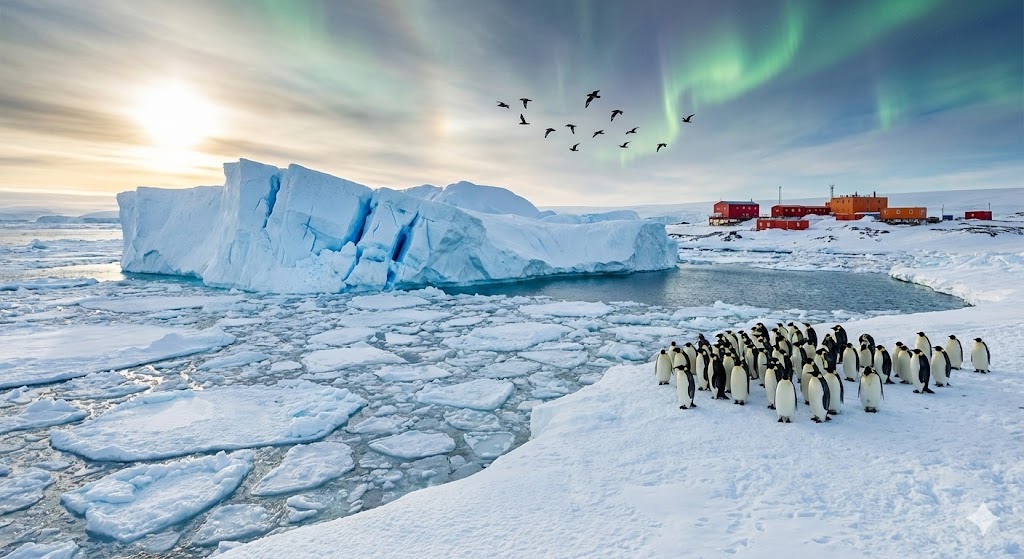
Scientist: Tonight I'm going to talk to you about that remarkable continent, Antarctica. Remote, hostile, and at present uninhabited on a permanent basis. For early explorers, it was the ultimate survival contest. For researchers like me, it remains a place of great intellectual challenge, while for the modern tourist, it's simply a wilderness of great beauty. First, some facts and figures. 1Antarctica is a place of extremes, the highest, coldest, and windiest continent, and over 58 times the size of The UK. The ice cap contains almost 70% of the world's fresh water and 90% of its ice. 2But with very low snowfall, most of the continent technically falls unbelievably into the category of desert. Huge icebergs break off the continent each year, while in winter, half an ocean freezes over, which means its size almost doubles. Research and exploration has been going on in Antarctica for more than two hundred years and has involved scientists from many different countries, who work together on research stations. 3Here, science and technical support have been integrated in a very cost effective way. Our Antarctic research program has several summers only stations and two all year round ones. I was based on one of the all year round ones. The research stations are really self contained communities of about 20 people. 4There's living and working space, a kitchen with a huge food store, a small hospital, and a well equipped gym to ensure everyone keeps fit in their spare time. The station generates its own electricity and communicates with the outside world using a satellite link. Our station, zero one, had some special features. It wasn't built on land but on an ice shelf, hundreds of meters thick. 5Supplies were brought to us on large sledges from a ship 15 kilometers away at the ice edge. Living in the Antarctic hasn't always been so comfortable. Snow build ups caused enormous problems for four previous stations on the same site, which were buried and finally crushed by the weight. Fortunately, no one was hurt, but these buildings became a huge challenge to architects, who finally came up with a remarkable solution. 6The buildings are placed on platforms, which can be raised above the changing snow level on legs which are extendable. Food is one is one of the most important aspects of survival in a polar climate. People living there need to obtain a lot more energy from their food, both to keep warm and to undertake heavy physical work. Maybe you know that an adult in The UK will probably need about 1,700 kilocalories a day on average. 7Someone in Antarctica will need about 3,500, just over double. This energy is provided by foods which are high in carbohydrate and fat. Rations for fieldwork present an additional problem. They need to provide maximum energy, but they must also be compact and light for easy transport. Special boxes are prepared, each containing enough food for one person for twenty days. You may be familiar with coffee processed by freeze-drying, which preserves the quality of the food product while making a large saving in weight-well, this type of presentation is ideal in our situation. It wasn’t available to earlier polar explorers, whose diet was commonly insufficient for their health. I think that being at the cutting edge of science has a special appeal for everyone working in Antarctica, in whatever capacity. As a marine biologist, my own research was fascinating; but it’s perhaps climate change research that is the most crucial field of study. Within this general field, surveying changes in the volume and stability of the ice cap is vital, 8since these may have profound effects on world sea levels and on ocean currents. A second important area is monitoring the size of the hole in the ozone layer above Antarctica since this is an indicator of global ultra-violet radiation levels. 9Thirdly, bubbles in the ice sheet itself provide an index of pollution because frozen inside them are samples of previous atmospheres over the past 500,000 years, and these provide us with evidence for the effects of such human activities as agriculture and industry. 10There are an increasing number of opportunities for young people to work for a period in Antarctica – not only as research assistants in projects like mine but also in a wide range of junior administrative and technical positions including vacancies for map-makers. I hope that the insights I’ve provided will encourage you to take up these opportunities in this fascinating continent.
![[Forecast Q2-2025] - Biology lecture](https://static.helik.app/reading/8fd3d7d2-ccf9-47a3-8920-2e7a3b0d6607)
![[Forecast Q2-2025] - Living in the City](https://static.helik.app/reading/1a60bcf3-f3a7-4e9b-97a2-94d156a0de3b)
![[Forecast Q2-2025] - Student Union](https://static.helik.app/reading/fb443123-8c1d-447e-8c79-5a01650f4754)
![[Forecast Q2-2025] - Fruit-picking Job in an Orchard](https://static.helik.app/reading/e1968346-6c55-44ae-b8d3-f6a4fb7207b9)
![[Forecast Q2-2025] - University Crime Prevention](https://static.helik.app/reading/bdda593e-16d6-4c72-8a12-b116e917b27c)
![[Forecast Q2-2025] - Business Course](https://static.helik.app/reading/3308e282-99a6-4bcb-9d22-0b488701d968)
![[C20T1] - Choosing a restaurant](https://static.helik.app/reading/e9b21123-c43c-42fb-88b7-5d0be3a37e03)
![[Helik Collect] - Car Club Scheme](https://static.helik.app/reading/6a749ba0-4cde-47fe-8260-f65b0599c3bf)