Lecturer: For the last few sessions, we've been looking at different architecture for both their utilitarian purposes and aesthetic features as well. In today's lecture, I want to continue this series by first introducing to you a unique underground museum in Japan and then we'll discuss the pros and cons of underground architecture.
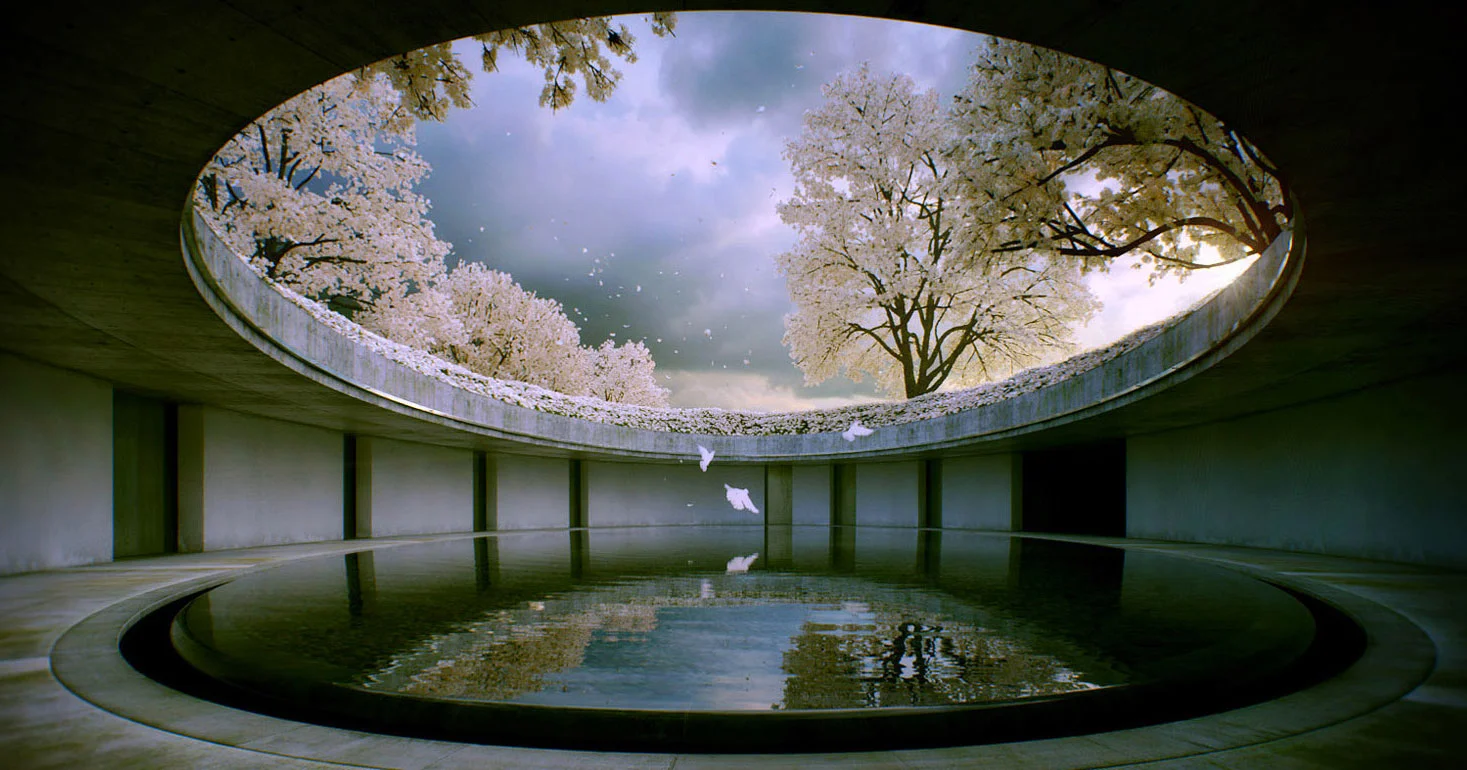
Now this museum was built in 1996 and around 80% of the museum is buried underground to preserve the lush natural beauty. It houses an impressive collection of artworks. The exhibits consist of works from ancient civilizations, including the Egyptians, Romans, and various Asian cultures, with the pieces mainly coming from the founders' private collection.
But perhaps the most intriguing aspect of the museum is the design of its structures and how they are integrated into their natural surroundings. 1The museum is humbly embedded in mountains close to a subway station connecting the nearest metropolis in about an hour. 2The design was inspired by an ancient Chinese story titled Peach Blossom Valley. The architect read it when he was a schoolboy. It is about a fisherman who loses his way and his boat carries him upstream.
He is drawn into a cave by the fragrant scent of a forest of blossoming peach trees. After traveling through a narrow road behind the cave, the man finds an idyllic village amid the splendid view. 3The museum has been conceived as a real world version of this village. Visitors must pass through a tunnel first and then a cable bridge suspended over a gorge before arriving at the museum. The museum's details reflect the designer's innovative endeavor to break new ground.
The architect changed the design numerous times to ensure the building was in harmony with the natural landscape. It becomes evident as tourists walk around the building as the detail is very fastidious and makes for a unique experience. 4Once visitors enter the museum, a sloping roof made of wide expanses of glass draws their attention right away. 5The web-like structure filtered the light through and scattered it across the surface, making visitors feel like being outside with a vibrant backdrop of seasonal colors.
It is now clear that underground buildings have many advantages over traditional above-ground houses, and many architects are looking into the possibilities of this type of subsurface structure. The most important advantage of these houses, especially in the current scenario of environmental degradation, is that they can better preserve indigenous flora and fauna. But the advantages of underground architecture go beyond that. 6For one thing, the earth surrounding the homes absorbs noise and thus provides natural soundproofing, creating a quiet living space with privacy.
Choosing an underground house will be peaceful and calming even in a noisy region. 7Moreover, there is less part of underground houses that can catch fire. For the most part, wood is no longer needed for building a home underground. The concrete foundations and metal structures of these homes all ensure good fireproofing.
Now underground houses also have the potential to save energy in the long run as they can tap the Earth's heating or cooling power. The Earth's temperature doesn't vary as much as the temperature of the air outside. It ensures that even though the climate outside fluctuates between extremes, the conditions inside the subterranean homes remain more or less stable.
However, there are also concerns over earth-sheltered homes. There may be a psychological adjustment needed for a person shifting from a traditional above-ground house to an underground house. 8Many people feel there is insufficient space in underground buildings, 9but in fact these people also admit that they often visit shopping centers located in the basement and did not feel claustrophobic.
In addition, 10underground houses cannot be built in regions experiencing flooding due to their unique geographical location. And even for areas that are suited for underground structures, drainage should be planned carefully to prevent moisture retention. While the advantages far outnumber their drawbacks, it may be a good idea to wait a little longer for these houses to come mainstream.
![[Forecast Q2-2025] - Biology lecture](https://static.helik.app/reading/8fd3d7d2-ccf9-47a3-8920-2e7a3b0d6607)
![[Forecast Q2-2025] - Living in the City](https://static.helik.app/reading/1a60bcf3-f3a7-4e9b-97a2-94d156a0de3b)
![[Forecast Q2-2025] - Student Union](https://static.helik.app/reading/fb443123-8c1d-447e-8c79-5a01650f4754)
![[Forecast Q2-2025] - Fruit-picking Job in an Orchard](https://static.helik.app/reading/e1968346-6c55-44ae-b8d3-f6a4fb7207b9)
![[Forecast Q2-2025] - University Crime Prevention](https://static.helik.app/reading/bdda593e-16d6-4c72-8a12-b116e917b27c)
![[Forecast Q2-2025] - Business Course](https://static.helik.app/reading/3308e282-99a6-4bcb-9d22-0b488701d968)
![[C20T1] - Choosing a restaurant](https://static.helik.app/reading/e9b21123-c43c-42fb-88b7-5d0be3a37e03)
![[Helik Collect] - Car Club Scheme](https://static.helik.app/reading/6a749ba0-4cde-47fe-8260-f65b0599c3bf)