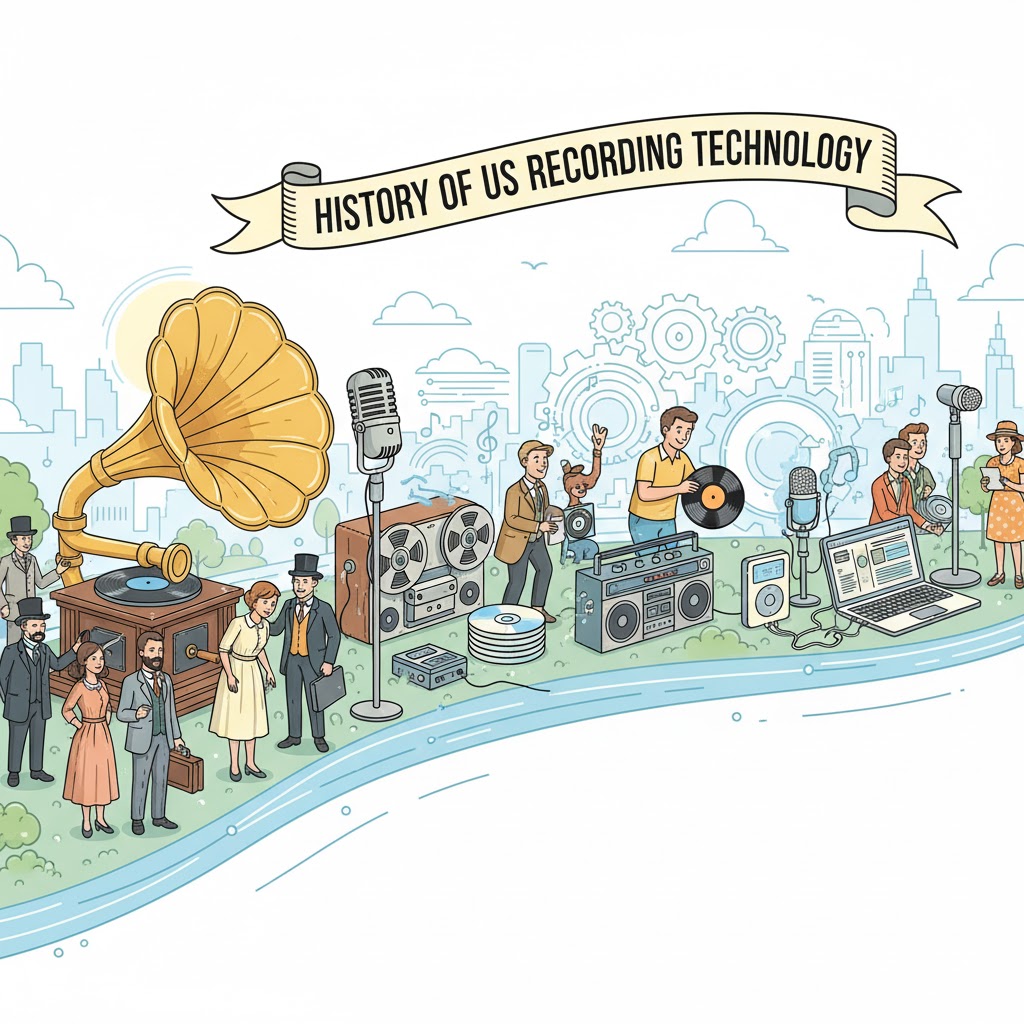
Lecturer: Last week, we looked at different styles of music in The United States, and today we want to look at how developments in technology changed music and the way music was appreciated. Before music could be recorded, people enjoyed it in a very different way. Music could only be heard live. 1Popular music really began with the invention of new instruments that could easily be taken outside. They were played by marching bands in parades and in parks. These were the brass instruments, like trumpets and tubas. They were completely different from the delicate wooden instruments used in classical concerts for the elite of society. 2This new popular music was played at sports games, where people enjoyed singing along to popular songs. Music became accessible to more people. It had also become simpler and easier to enjoy, unlike the complexities of classical music. Tin Pan Alley was an area in New York that became synonymous with this change. 3There, some of the most important music publishers had their offices. Among these were Whitmark and Mills, and most of that catchy music was written there. What made this Tin Pan Alley style so popular was a line in the lyrics that was easy to remember, together with an uncomplicated straightforward melody. Agents promoted their songs through live shows, and then 4they sold the sheet music. Middle class urban families brought the music home and would spend evenings playing it on the piano and singing along. But recorded music changed forever the way Americans listened to and enjoyed music. In 1877, the inventor Thomas Edison first recorded music in his laboratory in Menlo Park, New Jersey. 5He created a way to capture sound through a horn and then transfer it with a needle that scratched grooves onto a tin cylinder. The cylinder was turned by a hand crank. By turning the crank in the opposite direction, the process could be reversed, and the music was played back. After experimenting with this, 6Edison began producing the cylinders from wax, which could easily be copied. People began collecting these cylinders. But he needed to find a way to have the cylinder turn at a constant speed so that the music could be reproduced faithfully. 7So he replaced the hand crank with a motor, driven by that new powerful tool, electricity. But the phonograph was really born in 1887, when Emile Berliner created a variation of Edison's invention a flat disc rather than a cylinder. One of the advantages of the disc was that it could hold recordings on both sides. This disc turned at 78 revolutions per minute, or RPM, which allowed about four minutes of music per side. The first commercial recordings were mainly of opera singers. This was 8because of the use of acoustic microphones. Usually, the singer would stand across the room at a great distance from the microphone and sing loudly or belt out his or her songs. The new microphones really favored the frequencies of the human voice. However, the musical instruments in these recordings were not reproduced well, and so were just a kind of background. One singer in particular, the Italian Enrico Caruso, was made famous by this new technology. For the first thirty years of the phonograph, Beethoven's Fifth Symphony was the only orchestral piece ever recorded. 9It required eight discs to contain the entire symphony. It was packaged in cardboard sleeves and sold as an album, as it was then called. These sold for $1, which would be about $20 today. In the nineteen twenties, the invention of the electric microphone changed the recording industry dramatically. It allowed singers to stand closer to the mic, giving a warmer, more intimate feel to the recorded voice. And this in turn created modern popular or pop singers like Frank Sinatra and Bing Crosby. Rather than belting out their songs, they sang soft, sweet melodies. 10These new microphones also improved the recording of classical music because they could pick up everything played, the whole range, from the highest flute to the lowest bass strings. The invention of the 33 RPM record allowed twenty three minutes of music per side. This made marketing classical music much more practical. But it was the pop singers who really sold records. From the development of the 33 RPM record through the nineteen sixties, 11there were a lot of advances for technicians using more modern equipment at the studio to record the albums, but not much for the consumers who bought the records. However, one thing certainly changed. 12The experience of listening to music went from being a public one to a private one. Music lovers were more likely to hear their favorite songs in the home rather than in a concert hall. And then the Dutch recording company Philips made it possible to record music onto magnetic tape. These were marketed as cassettes. The quality of sound wasn't as good, but 13they had the distinct advantage of being portable, so you could easily carry them to your friend's place. You could play them in your car. Soon, the market for cassettes was nearly equal to the market for records. And then in 1983, Philips, together with the Japanese corporation Sony, introduced the compact disc or CD.
![[Forecast Q2-2025] - Biology lecture](https://static.helik.app/reading/8fd3d7d2-ccf9-47a3-8920-2e7a3b0d6607)
![[Forecast Q2-2025] - Living in the City](https://static.helik.app/reading/1a60bcf3-f3a7-4e9b-97a2-94d156a0de3b)
![[Forecast Q2-2025] - Student Union](https://static.helik.app/reading/fb443123-8c1d-447e-8c79-5a01650f4754)
![[Forecast Q2-2025] - Fruit-picking Job in an Orchard](https://static.helik.app/reading/e1968346-6c55-44ae-b8d3-f6a4fb7207b9)
![[Forecast Q2-2025] - University Crime Prevention](https://static.helik.app/reading/bdda593e-16d6-4c72-8a12-b116e917b27c)
![[Forecast Q2-2025] - Business Course](https://static.helik.app/reading/3308e282-99a6-4bcb-9d22-0b488701d968)
![[C20T1] - Choosing a restaurant](https://static.helik.app/reading/e9b21123-c43c-42fb-88b7-5d0be3a37e03)
![[Helik Collect] - Car Club Scheme](https://static.helik.app/reading/6a749ba0-4cde-47fe-8260-f65b0599c3bf)