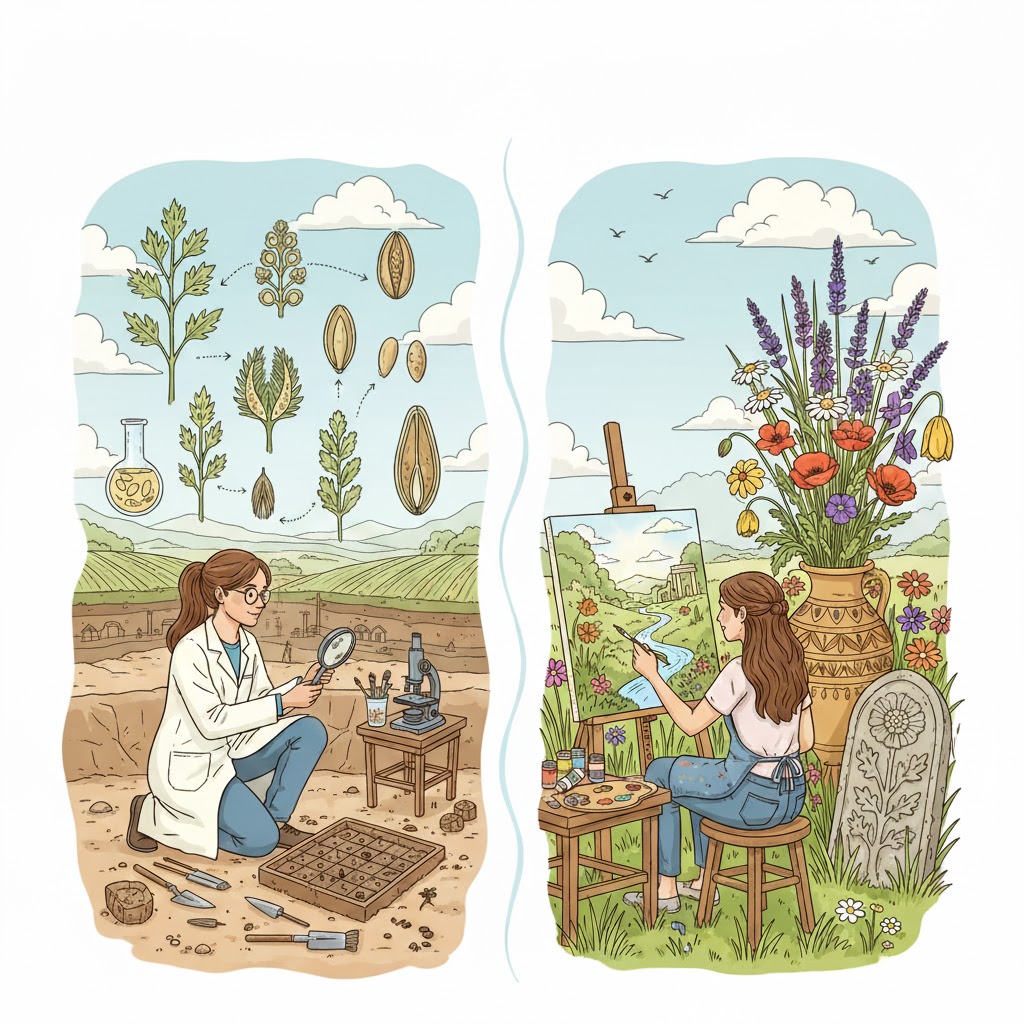
Speaker: Did you know there's a special subfield of archaeology that overlaps with botany? It's called archaeobotany. 1Archaeobotany involves the study of historical plants, typically the remains of plants from archaeological sites. But one Italian archaeobotanist called Dalla Ragione takes an unconventional approach to archaeobotany. To gather information about Italy's lost biodiversity, she's turned her focus to Renaissance art of the fifteenth and sixteenth centuries. To give a bit of background, Italy was a largely agrarian society up until the 1950s. 2At that time, Italy transitioned to an industrial economy, and many farmers fled to cities to look for jobs. Their centuries old practices were set to be lost. Farming itself also began to change. Large scale industrial farming 3led to the abandonment of crop varieties that did not grow fast enough, had low crop yields, or weren't able to be machine harvested. Dalla Ragione's interest in archaeobotany began in childhood, due in large part to these changes. Dalla Ragione's father, a farmer himself, had always taken an interest in preserving past farming practices, along with the plants that had once flourished in their region. As a girl, 4she would spend hours with him, looking for such plants in abandoned fields and also searching for equipment that was no longer being used. These finds could give important information about the region's agricultural history. She would later go on to study the genetic and cultural history of fruit at university. Dalla Ragione began her research career by combining traditional research methods, like going through archives with explorations of abandoned fields or orchards surrounding centuries old monasteries. In the mid-2000s, Dalla Ragione had a sort of revelation, I guess we could say. She was at the sixteenth century Bufalini Palace, studying a collection of invoices and recipes filled with references to historic plants. 5While she was working in the library there, she started to take note of the fruits and vegetables depicted in the colorful frescoes painted on the walls. Could they tell her anything about lost varieties of plants in that region? 6Dalla Ragione discovered that the artist of the frescoes had been encouraged to choose local fruits and vegetables as subjects. She then reasoned that because he painted fruits and vegetables that he'd seen, they must have grown on farmsteads in the surrounding region or in the palace's own orchard. Dalla Ragione was able to catalog and source most of the now rare varieties of fruits and vegetables once grown in her region, 7like a cucumber, known for its unusual white color, or tiny millet grains. Many of these fruits and vegetables now grow on her own twelfth century farmstead. Inspired by this discovery, she set out to study more Renaissance era paintings across Central Italy, but she soon realized that botanical details were often overlooked or misunderstood. 8Take Madonna and Child with the Pear, an oil on wood painting currently preserved at the Uffizi Gallery in Florence. The fruit's distinctive shape in the painting made Dalla Ragioni realize that it was not a pear, but actually a mouth of the ox apple, an old variety that she had found years before and which now grows on her farmstead. Dalleragioni's Study of the Virgin and the Child, a painting by artist Francesco Squaccione from the year 1460, led to the rediscovery of a kind of pear. Most art historians had referred to the fruit in the painting as an apple. But Dalla Ragione wasn't convinced. 9She searched for references to a flat apple in old manuscripts, but soon realized that what Squaccione depicted was in fact a para verdakia, a variety of pear once commonly used in her region to make baked goods. She searched farmsteads and monastic gardens across the Upper Tiber Valley, but 10eventually it was in Tuscany where she found it in a field and collected samples. So how does Dalla Ragione actively preserve nearly forgotten varieties of plants? She manages a foundation 11dedicated to the preservation of fruit trees that used to grow in her region. Once she finds a long lost fruit tree, Dalla Ragione plants three samples in her farmstead, and anyone can adopt these trees through her foundation's website. She personally takes care of her 600 plants year round. She grows mostly apple and pear trees, but there are also about a dozen cherry varieties in her orchard. When she's not tending to her fruit trees, she continues to search for other elusive varieties of plants. She's still on the hunt for a particular type of fig, called the Ricorondinino di San Sepolcro, for example. She acknowledges that sometimes 12the difficulty in identifying plants can come down to something as simple as the fact that their name is no longer the same as it was in the past. In other words, the lost variety isn't really lost at all it's just being called something different. The mission statement of Dalla Ragione's foundation is based on the belief that plants are an essential element of cultural heritage. Dalla Ragione stresses that communities used to revolve around plants, and points out that 13Italians of the past even took seeds with them as they migrated across the Atlantic to The Americas. They considered plants as core to their identity.
![[Forecast Q2-2025] - Biology lecture](https://static.helik.app/reading/8fd3d7d2-ccf9-47a3-8920-2e7a3b0d6607)
![[Forecast Q2-2025] - Living in the City](https://static.helik.app/reading/1a60bcf3-f3a7-4e9b-97a2-94d156a0de3b)
![[Forecast Q2-2025] - Student Union](https://static.helik.app/reading/fb443123-8c1d-447e-8c79-5a01650f4754)
![[Forecast Q2-2025] - Fruit-picking Job in an Orchard](https://static.helik.app/reading/e1968346-6c55-44ae-b8d3-f6a4fb7207b9)
![[Forecast Q2-2025] - University Crime Prevention](https://static.helik.app/reading/bdda593e-16d6-4c72-8a12-b116e917b27c)
![[Forecast Q2-2025] - Business Course](https://static.helik.app/reading/3308e282-99a6-4bcb-9d22-0b488701d968)
![[C20T1] - Choosing a restaurant](https://static.helik.app/reading/e9b21123-c43c-42fb-88b7-5d0be3a37e03)
![[Helik Collect] - Car Club Scheme](https://static.helik.app/reading/6a749ba0-4cde-47fe-8260-f65b0599c3bf)