Answers For [Helik Collect] - Sleep Paralysis
Answers and detail explain for [Helik Collect] - Sleep Paralysis
Explain
[Helik Collect] - Sleep Paralysis
2Most nights, people experience dreams, partly due to a phase of the sleep cycle known as REM (Rapid Eye Movement) sleep, during which the brain is highly active and dreams are particularly vivid and complex.1Throughout this state, our bodies are still except for the muscles needed to move the eyes and to breathe, perhaps in order to stop dreamers from acting out and being put in harm's way. 3This almost complete paralysis is called atonia and is caused by motor neurons, small nerve endings located in the spinal cord. Although this is entirely normal during sleep, atonia can occur while a person is awake. This phenomenon is called sleep paralysis.
An infrequent but perfectly safe condition, during sleep paralysis the mind is awake but, due to atonia, the body is paralyzed for up to several minutes. 4-5This can result in an inability to move or speak, a feeling of pressure on the chest, difficulty breathing and an inexplicable fear or feeling of dread. In some, the inability to move their eyes can occur, whereas others find that these are the only part of the body they can move. 6Many also experience hallucinations during sleep paralysis, varying from believing a malevolent presence to be in the room, to more complex hallucinations including hearing, smelling or feeling things that are not there. In more extreme cases, people have reported forced or wilful out-of-body experiences. Understandably, these effects can be very frightening for the individual, even though there is no danger.
Documented interest in sleep paralysis goes back as far as Ancient Greece, but has not always been thought of as a medical issue. Paulus Aegineta, a Byzantine Greek physician, wrote about a disorder called 'ephialtes' in his medical encyclopaedia Medical Compendium in Seven Books. According to Paulus, the sufferer of ephialtes experiences the sensation of being suffocated and unable to move as a demon presses down on them. The being may speak while attempting to suffocate them, then flees when they strive to grasp it. 8Aegineta believed such an affliction was a forerunner of another disease and that the demon behind it would return every night during its initial visit to torment the sleeper. This perception of sleep paralysis is mirrored across many cultures.
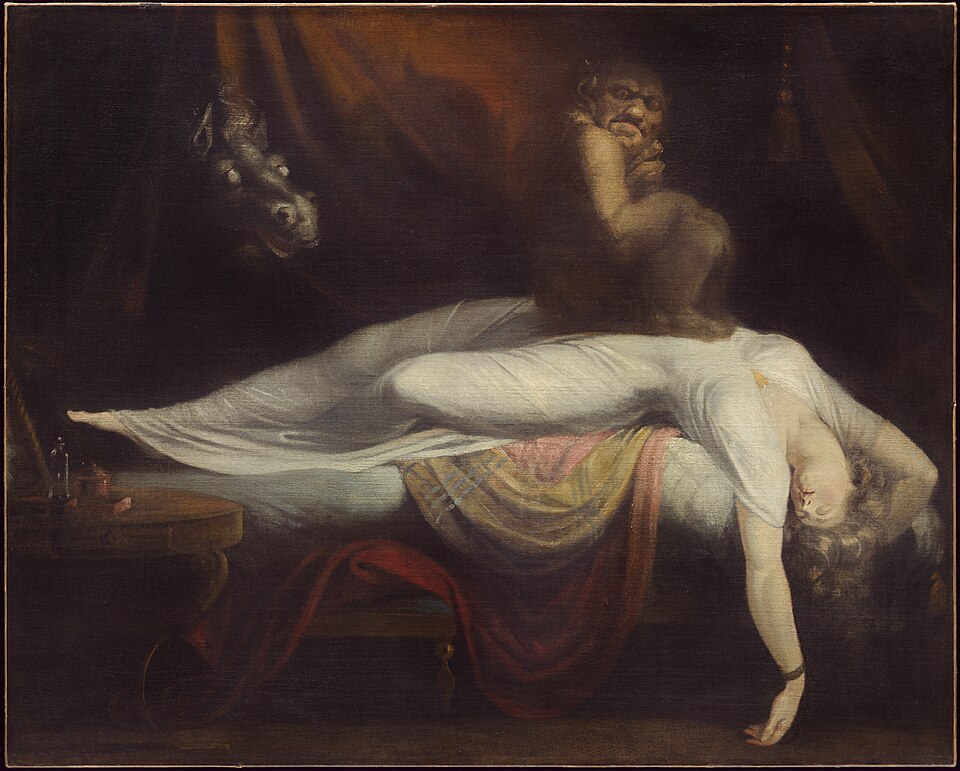
12British folklore talks of the Old Hag, an entity who sits on people's chests while they sleep and causes them to have nightmares. When the sleeper awakes, the Old Hag disappears, leaving the person unable to speak or move temporarily. 9The Old Hag also appears in other European cultures, commonly known as 'mara' and causing similar effects on its victims. Beyond these broad similarities, further details differ from culture to culture. In Japan, evil spirits - known as 'kanashibari' - tie up victims with iron ropes, whereas the Inuit attribute the phenomena to a shaman placing a curse upon the victim. Despite these differences, it is clear that most pre-Enlightenment cultures believed that rather than a natural occurrence in the human body, sleep paralysis was attributed to an external threat, someone or something that wished to harm them. 18th-Century artist Henry Fuseli is well known for oil painting 'The Nightmare', depicting a woman with a demonic creature sitting on her chest, and a possessed horse skulking near the bed. This painting is commonly perceived as depicting sleep paralysis, as the incubus puts pressure on the chest, causing the shortness of breath typical of the condition. Furthermore, the woman is painted as lying on her back, a position which even in modern medicine is considered to lead to or exacerbate sleep paralysis. 11It is believed that Fuseli was inspired by Germanic tales of hags and mara in his creation of this artwork.
Given that people in the past attributed sleep paralysis to supernatural causes, it is unsurprising that they also believed it was a precursor to illness or could even lead to death. Even when a rational, medical explanation for the condition exists, some people still believe it is more than just an anomaly in sleeping patterns. 10Some theories attribute sleep paralysis to ‘shadow people’ – entities with a human form found in the shadows watching over victims while they sleep. Those who have ‘met’ these gloomy figures, often hallucinate about long shadows and strange shapes. The widely documented nature of these hallucinations gives many consider proof of the shadow people’s existence. 7Alternatively, many conspiracy theorists believe sleep paralysis is caused by alien activity, as the majority of those claiming to be victims of alien abduction describe the encounter as being similar to sleep paralysis: inexplicable anxiety, hearing buzzing or humming sounds and sensing a potentially harmful presence.
13It appears some aspect of the human psyche has always been attracted to bizarre and supernatural explanations for an affliction that, although potentially alarming, is entirely benign. Although the mechanics are now understood by modern medicine, the root causes of sleep paralysis still remain vague and unconfirmed. It has been known to narcolepsy, its likelihood increasing through irregular sleeping patterns or insomnia. Nonetheless, a definitive cause has yet to be determined and this strange phenomenon is likely to continue to attract supernatural speculation until we discover what exactly provokes it.
Questions 1-3
Choose THREE letters, A–G.
According to the passage, what is true of normal REM sleep?
A.
B.
C.
D.
E.
F.
G.
Questions 4-6
Choose THREE letters, A–G.
What can happen to people during an attack of sleep paralysis?
A.
B.
C.
D.
E.
F.
G.
Questions 7-12
Look at the following statements and the list of figures below. Choose the correct figure and put them in boxes 7-12.
List of figuresCT Conspiracy theoristsHF Henry Fuseli OH The Old Hag PA Paulus Aegineta SP Shadow People |
7
Can draw parallels between a personal experience and the symptoms of sleep paralysis
8
Believed sleep paralysis to be a sign of underlying health problems
9
Can be referred to by an alternative name depending on which country you are in
10
Is/are believed by many to exist due to the extensive recording of visions
11
Received inspiration from folklore
12
Is/are thought to cause bad dreams
Question 13
Choose the correct letter, A, B, C, or D.
![[Recent Tests- VOL] - A Brief Introduction to Pepper](https://static.helik.app/reading/2250f746-b094-476e-a25e-a47a21c27072)
![[Recent Tests- VOL] - Classifying societies](https://static.helik.app/reading/e93c3418-dcc0-4095-96eb-ee3951a68289)
![[Recent Tests- VOL] - The Blockbuster Phenomenon](https://static.helik.app/reading/2f76f74f-39e0-45b8-8c43-ff5bac22ee2b)
![[Recent Tests- VOL] - Saving the Bittern](https://static.helik.app/reading/4f428d53-643b-477c-afb1-d6f0cee2e8fb)
![[Recent Tests- VOL] - Ambergris](https://static.helik.app/reading/b6be70ec-fa99-41ea-876e-4058cfbab0cd)
![[Recent Tests- VOL] - Developmental Tasks of Normal Adolescence](https://static.helik.app/reading/69287e43-4020-4dea-9c3e-54bc2c48bab8)
![[Recent Tests- VOL] - Corporate Social Responsibility](https://static.helik.app/reading/4034faff-df5e-4727-af9c-fe17355ea7eb)
![[Recent Tests- VOL] - Amateur Naturalists](https://static.helik.app/reading/9177a84f-590c-4379-b00a-5c18b76c217d)