Answers For [Helik Collect] - The tuatara: past and future
Answers and detail explain for [Helik Collect] - The tuatara: past and future
Explain
[Helik Collect] - The tuatara: past and future
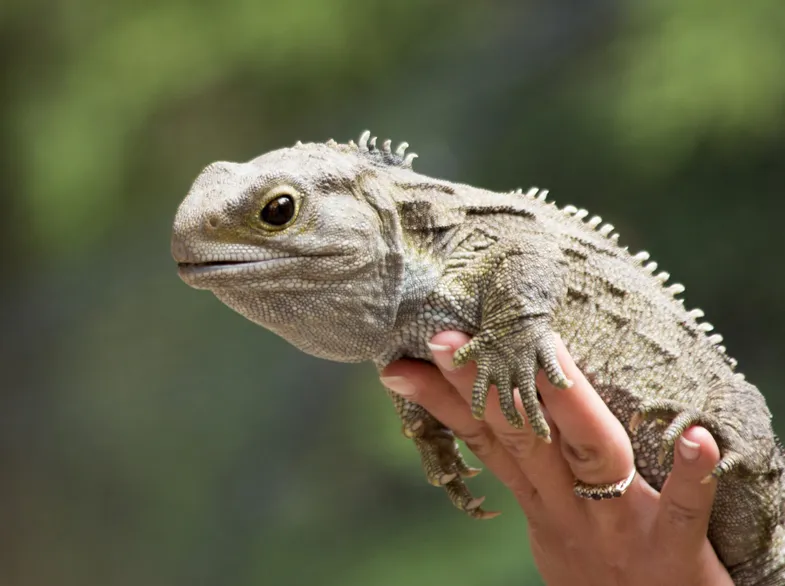
The New Zealand species of lizard, the tuatara, is firmly embedded in the national psyche: an icon for today which dates from the age of dinosaurs; an ancient reptile commemorated on the back of the five cent coin. New Zealanders feel an affinity with the tuatara, and accept that active conservation management is required to ensure it will be among the legacies left to future generations.
1When European explorers reached New Zealand in 1769 they found two large islands, which together they called the 'mainland', and many tiny offshore islands around the coast. The naturalists who came with the explorers disregarded the tuatara, though it is improbable none were seen. Only several decades later did a tuatara specimen reach the British Museum, where it was eventually classified as just another type of lizard. One of the first scientists who realized that aspects of tuatara anatomy were odd - unchanged for tens of thousands of years - was Albert Gunther in 1876. Gunther believed the tuatara was one of the most valuable objects in zoological anatomical collections, and also noted, in passing, the reptile was likely to become extinct. 2From today's perspective, it is striking that Gunther expressed no concern about the probable demise of the tuatara. He and his contemporaries were products of their age, strongly influenced by Charles Darwin's theory, which had only recently been published. Their views were something like this: Extinction is a natural process. It is sad that species disappear, but that is part of nature.
There is a second important aspect of Gunther's work. He recorded, correctly, that some of the mammals introduced by Europeans were predators of the tuatara - particularly rats. 3But what he did not realise was that New Zealand has two species of rat, both introduced, both with an appetite for tuatara: the ship's rat came with European explorers and settlers, but the kiore rat had already been in the country for hundreds of years, brought by Polynesians from the Pacific Islands. Gunther failed to recognise the distinction, believing all rats to be a relatively recent introduction.
Little further research was conducted until Ian Crook of the NZ Wildlife Service published his findings in 1973, which can be summarised as follows. Tuatara thrive on offshore islands with no rats. Tuatara never survived on islands with ship's rats. On a few islands, small and declining populations of tuatara occur with the kiore. 4This should not be seen, however, as evidence that tuatara and kiore can coexist. Rather, Crook proposed, kiore probably only arrived recently on such islands, and thus the small populations represent extinctions in progress.
5Throughout the 1990s, Richard Holdaway and his colleagues at Victoria University in Wellington documented the surprising discovery that kiore probably arrived about 1800 years ago, although the human population of New Zealand is thought to be no older than 800 years. How is this possible? Presumably, Holdaway argued, the kiore were brought by Polynesian explorers who visited the country but did not settle. Thereafter, the rats were agents of ecological warfare, exterminating perhaps 1000-3000 species. Thus, tuatara and many other species were already rare or extinct when permanent human inhabitants - the Maori - arrived around 1300. 6This hypothesis is still being debated, but the evidence continues to accumulate in its favour.
7-8Conservation practice has changed dramatically since Crook's findings were published in 1973. Eradication of rats from any given environment was believed to be virtually impossible until about 1980, but since then has become routine. Enormous conservation benefits are accruing as newly rat-free offshore islands are providing sanctuaries for the country's rarest species. In 1995, for example, Nicola Nelson of the Department of Conservation established 68 tuatara on Ti Island. Since then, four more populations of tuatara have been established elsewhere under similar conditions. 9Today, numbers of tuatara are still a fraction of what they once were, but for the first time in 1800 years the decline has been reversed.
10While the recovery of rare species is itself a good thing, the truly significant outcome of this research is that it liberates the imagination. If we can remove predatory introduced mammals from islands, why not from the mainland too? Perhaps the questions we ask should demonstrate even more visionary ambition. Can non-mammalian pests also be removed from the mainland? 12Our rivers, for example, are full of surrogate rats, in the form of introduced species of fish called trout. Some day more people will understand that trout have replaced a whole native fauna in our waterways, just as rats replaced tuatara on the mainland. 11Will such knowledge lead to the creation of mainland aquatic islands where we can once again establish those species of indigenous fish that used to live in our rivers? Similarly, can bellbirds and tuis replace birds like starlings and mynahs?
The answers to such questions are uncertain, and opposing sides will doubtless be fiercely debated. But the role of scientific knowledge in illuminating the past will be crucial. 14Just as we now no longer tolerate extinction, in the future we may no longer accept a mainland devoid of the biological wonders of our past such as tuatara. 13Conservation is thus not primarily about the past but about imagining and then creating the future we wish for our children and ourselves. For 80 million years until humans arrived, tuatara occurred throughout New Zealand - might they do so again?
Questions 1-5
Choose the correct letter, A, B, C or D.
Write the correct letter in boxes 1-5 on your answer sheet.
1What are we told about the Europeans who arrived in 1769?
2What does the writer say about Albert Gunther in paragraph 2?
3What did Albert Gunther think about the rats in New Zealand?
4What did Ian Crook conclude from his research?
5What were the findings of Richard Holdaway's research?
Questions 6-9
Do the following statements agree with the claims of the writer in Reading Passage 3?
In boxes 6-9 on your answer sheet, write:
YES if the statement agrees with the claims of the writer
NO if the statement contradicts the claims of the writer
NOT GIVEN if it is impossible to say what the writer thinks about this
6
6
The available research supports Holdaway's theory but it has not been proved.
7
7
Nowadays, it is possible to totally destroy a population of rats on a small island.
8
8
Crook was the first person to recognize the potential of offshore islands as sanctuaries.
9
9
Tuatara numbers are continuing to fall.
Questions 10-14
Complete the summary using the list of words below. Write the correct letter, A-H, in boxes 10-14 on your answer sheet.
| A. natural evolution | B. imagination | C. indigenous plants | D. trout |
| E. pollution | F. possibility | G. native fish | H. extinction |
What conclusions can we draw?The most important result of the tuatara research is that it frees our 10 (B) . Should we now go further and consider reintroducing 11 (G) to our mainland rivers? For example, there are many similarities between rats and 12 (D) . Perhaps our children will come to believe in the 13 (F) of species, in the same way that our generation refuses to accept 14 (H) . |
![[Recent Tests- VOL] - A Brief Introduction to Pepper](https://static.helik.app/reading/2250f746-b094-476e-a25e-a47a21c27072)
![[Recent Tests- VOL] - Classifying societies](https://static.helik.app/reading/e93c3418-dcc0-4095-96eb-ee3951a68289)
![[Recent Tests- VOL] - The Blockbuster Phenomenon](https://static.helik.app/reading/2f76f74f-39e0-45b8-8c43-ff5bac22ee2b)
![[Recent Tests- VOL] - Saving the Bittern](https://static.helik.app/reading/4f428d53-643b-477c-afb1-d6f0cee2e8fb)
![[Recent Tests- VOL] - Ambergris](https://static.helik.app/reading/b6be70ec-fa99-41ea-876e-4058cfbab0cd)
![[Recent Tests- VOL] - Developmental Tasks of Normal Adolescence](https://static.helik.app/reading/69287e43-4020-4dea-9c3e-54bc2c48bab8)
![[Recent Tests- VOL] - Corporate Social Responsibility](https://static.helik.app/reading/4034faff-df5e-4727-af9c-fe17355ea7eb)
![[Recent Tests- VOL] - Amateur Naturalists](https://static.helik.app/reading/9177a84f-590c-4379-b00a-5c18b76c217d)