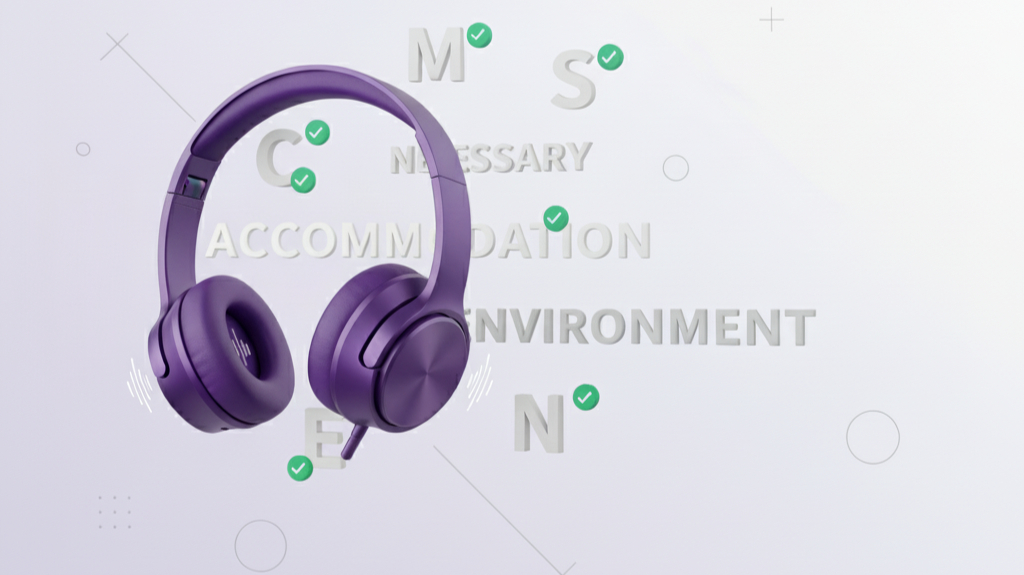
Why Spelling Matters More Than You Think in IELTS Listening
Why Spelling Matters More Than You Think in IELTS Listening
Imagine this: You're sitting in your IELTS exam, headphones on, listening intently to the audio. You hear the answer clearly — "accommodation" — and you write it down confidently. But when you get your results, you realize you spelled it "accomodation" (with one 'm'). Zero marks.
This scenario happens to thousands of IELTS test-takers every year. In the IELTS Listening test, spelling accuracy is non-negotiable. Even if you understand the audio perfectly, one wrong letter means you lose the point entirely. That's why we've created a powerful new feature to help you master both listening comprehension and spelling accuracy: Spelling Practice.
📊 Did You Know?
According to IELTS examiners, spelling mistakes are among the top 3 reasons test-takers lose points in the Listening section, especially for words like "necessary," "environment," "government," and "accommodation."
Introducing Spelling Practice: Your New Secret Weapon
Our new Spelling Practice feature is designed specifically to bridge the gap between hearing and writing. It's not just about memorizing spellings — it's about training your brain to connect sounds with letters in real-time, just like you'll need to do on exam day.

Source: unsplash
How It Works
The concept is beautifully simple but incredibly effective:
- Listen to authentic sentences from real IELTS-style audio recordings
- Type what you hear word-for-word, focusing on accuracy
- Get instant feedback on your spelling and comprehension
- Review your mistakes and learn from patterns
- Track your progress as you improve over time
Each practice session includes multiple sentences covering common IELTS topics like education, environment, technology, health, and business — the exact themes you'll encounter in your actual test.
Key Features That Make a Difference
🎧 Variable Playback Speed
Struggling to catch every word? Start at 0.75x speed to train your ear, then gradually increase to normal speed as you improve. This progressive approach helps you build confidence while developing the listening skills you need for the actual exam.
💡 Smart Hints System
When you're stuck, our hint system provides strategic clues:
- Word count — Know how many words you're listening for
- First letters — Get the starting letters of each word
- Full reveal — See the complete answer when you need it
Use hints strategically to learn, not just to complete exercises. The goal is understanding, not just finishing.
✅ Instant Feedback & Error Analysis
After each sentence, you'll see:
- Which words you spelled correctly (highlighted in green)
- Which words need improvement (highlighted in red)
- The correct spelling for comparison
- Common mistakes and why they happen
This immediate feedback loop is crucial for learning. Your brain makes connections faster when you see corrections right away.
📊 Progress Tracking
Watch your improvement over time with detailed statistics:
- Accuracy percentage per session
- Most commonly misspelled words
- Completion rate and consistency
- Areas that need more practice
5 Pro Tips to Maximize Your Spelling Practice
1. Listen Multiple Times at Different Speeds
Don't rush! Start at 0.75x speed to catch every sound, then replay at normal speed. This trains your ear to recognize pronunciation patterns and helps you distinguish between similar-sounding words like "their," "there," and "they're."
2. Write What You Hear, Not What You Think
Resist the urge to autocorrect in your mind. If you hear "gonna," don't automatically write "going to" unless that's what you actually heard. This builds the crucial connection between sounds and spelling that you need for exam success.
3. Use Hints Strategically
Hints are learning tools, not shortcuts. Try listening 2-3 times before using a hint. When you do use one, focus on understanding why you missed it. Was it pronunciation? Vocabulary? Spelling knowledge?
4. Review Your Mistakes Immediately
Don't just move on after getting something wrong. Study the correct spelling, say it out loud, and write it down 3-5 times. This reinforcement helps transfer the word from short-term to long-term memory.
5. Practice Daily for 10-15 Minutes
Consistency beats intensity. Fifteen minutes of daily practice is far more effective than cramming for hours once a week. Make it part of your morning routine or evening wind-down.
The Science Behind Spelling Practice
Our Spelling Practice feature is built on proven learning principles:
Spaced Repetition
By practicing regularly, you encounter the same challenging words multiple times over days and weeks. This spaced repetition is scientifically proven to improve long-term retention by up to 200% compared to cramming.
Active Recall
Instead of passively reading or listening, you actively retrieve information by typing what you hear. This active recall strengthens neural pathways and makes information easier to access during your exam.
Immediate Feedback
Research shows that immediate feedback is crucial for learning. When you see corrections right away, your brain can adjust and form correct associations before errors become habits.
Contextual Learning
You're not just memorizing isolated words — you're learning them in context, within complete sentences. This mirrors how you'll encounter them in the actual IELTS test, making your practice more relevant and effective.
Common IELTS Spelling Traps (And How to Avoid Them)
Here are the most commonly misspelled words in IELTS Listening, based on examiner reports:
| Word | Common Mistake | Memory Tip |
|---|---|---|
| accommodation | accomodation (one 'm') | Two 'c's, two 'm's — double trouble! |
| necessary | neccessary, neccesary | One collar (c), two sleeves (s) |
| environment | enviroment (missing 'n') | Iron in the environment |
| government | goverment (missing 'n') | Govern + ment |
| separate | seperate | There's "a rat" in separate |
| definitely | definately | Finite is in definitely |
| occurred | occured (one 'r') | Double 'c', double 'r' |
| receive | recieve | I before E except after C |
Our Spelling Practice feature includes all these tricky words and many more, giving you targeted practice on the spellings that matter most for your IELTS score.
Real Student Success Stories
"I was consistently scoring 6.5 in Listening practice tests, mainly because of spelling mistakes. After using Spelling Practice for just two weeks, my accuracy improved dramatically. In my actual IELTS exam, I scored 8.0 in Listening! The daily practice made such a difference."
— Maria S., Brazil (IELTS Listening: 8.0)
"As a non-native English speaker, I always struggled with words that sound different from how they're spelled. The variable speed feature was a game-changer — I could slow down the audio and really hear each syllable. My spelling accuracy went from 70% to 95%."
— Ahmed K., Egypt (IELTS Listening: 7.5)
How to Get Started Today
Ready to transform your IELTS Listening preparation? Here's how to start:
- Log in to your Helik account (or create a free account if you're new)
- Navigate to the Listening section from your dashboard
- Click on "Spelling Practice" to access the feature
- Choose your first practice set and start listening
- Commit to 10-15 minutes daily for the next two weeks
🎯 Your 14-Day Challenge
We challenge you to practice for just 10 minutes every day for the next 14 days. Track your progress and watch your accuracy improve. Students who complete this challenge typically see a 20-30% improvement in spelling accuracy!
Frequently Asked Questions
How long should I practice each day?
We recommend 10-15 minutes of focused practice daily. This is enough to make significant progress without causing fatigue. Consistency is more important than duration.
Is this suitable for all IELTS band levels?
Absolutely! Whether you're aiming for Band 6.0 or Band 9.0, spelling accuracy is crucial. Our practice sets include sentences of varying difficulty to match your level.
Can I use this on mobile devices?
Yes! The Spelling Practice feature is fully responsive and works seamlessly on smartphones, tablets, and desktop computers. Practice anywhere, anytime.
How is this different from regular listening practice?
Regular listening practice focuses on comprehension. Spelling Practice specifically targets the connection between hearing and writing accurately — a skill that's tested directly in IELTS Listening but often overlooked in general practice.
Will this help with other IELTS sections?
While designed for Listening, improved spelling accuracy benefits your Writing section too. Plus, the vocabulary you encounter will help with Reading comprehension and Speaking fluency.
The Bottom Line
In IELTS Listening, understanding the audio is only half the battle — you must also spell your answers correctly. Our new Spelling Practice feature gives you targeted, effective practice that directly translates to higher scores on test day.
Don't let simple spelling mistakes cost you valuable points. Start practicing today and build the confidence you need to ace the IELTS Listening section.
Ready to Master IELTS Listening?
Join thousands of students who are improving their spelling accuracy every day.
Try Spelling Practice FreeAbout the Author: This article was created by the Helik team, dedicated to helping IELTS students achieve their target scores through innovative, effective learning tools. Have questions or feedback? Contact us — we'd love to hear from you!
Comments